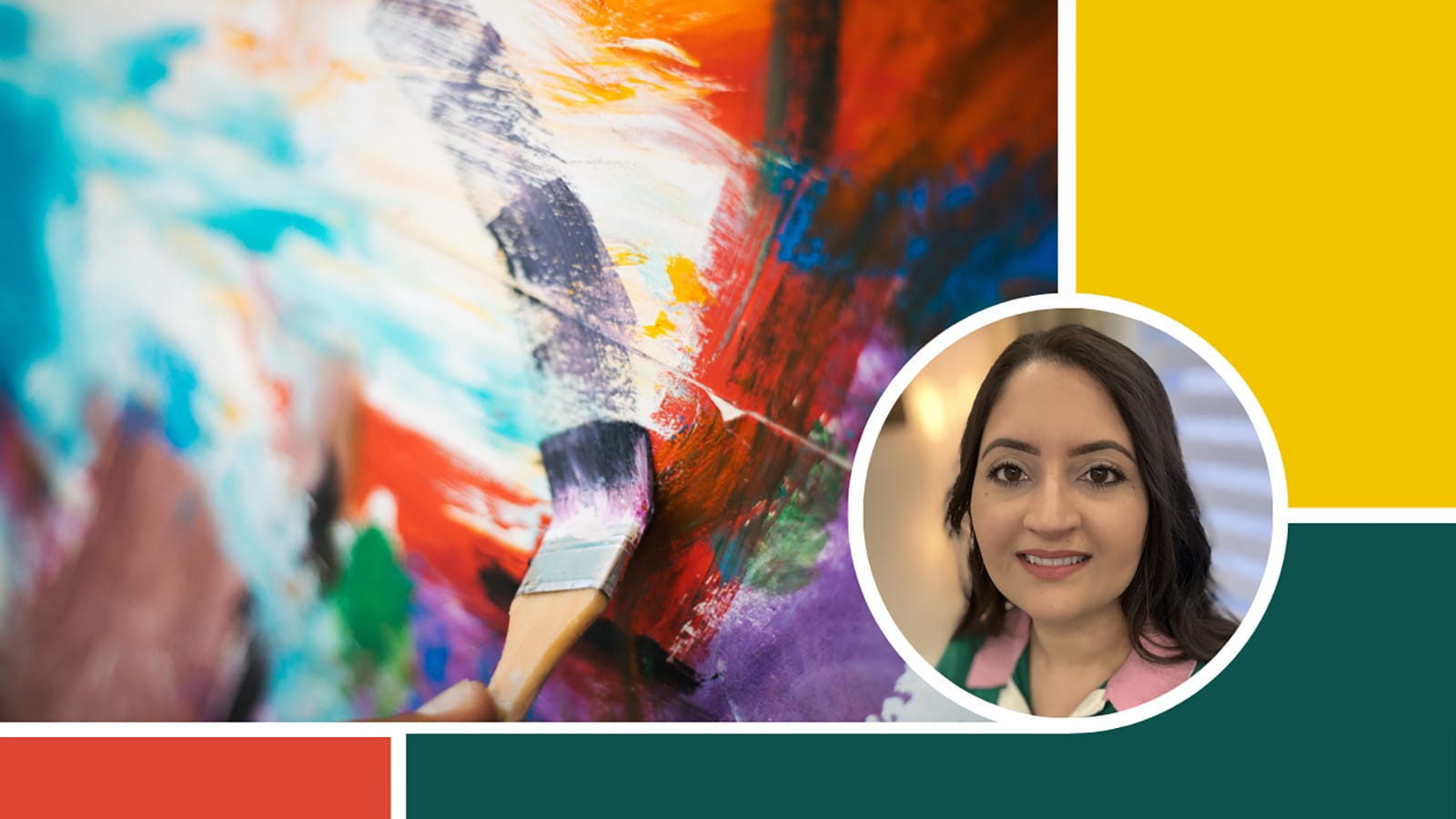
Special feature by Zeynep Zuhal Arslan for the NBM Lab
Amid the uncertainty of the chemotherapy clinic with a constant hum of machines and footsteps of healthcare professionals, we find Preet Ahluwalia, an art therapist at Sunnybrook Odette Cancer Centre, approaching patients with a calming, “How has today been for you?”
In the outpatient setting, everything moves at a fast pace, but Preet has adapted to that rhythm and meets patients at their treatment chairs with her cart full of art tools and a warm smile. She listens to patients carefully and helps create an expressive space where they can articulate the feelings that come with the physical and emotional fatigue associated with cancer treatment. The interactions that patients have with Preet allow for moments of lightness, humanity, and connection in the middle of something very hard. In one such moment, a patient introduced Preet to his daughter during treatment, saying, “This is Preet, she has the best job in the world and gets to bring joy to everyone here,” a reflection that speaks to the impact of her presence in the clinic.
Preet’s path into art therapy was a personal one: her diagnosis of advanced ovarian cancer in her twenties turned her world upside down. Beyond the hardship of surgeries and chemotherapy, she recalls the most difficult part was the emotional isolation she felt away from her family in the UK. Several years later, after studying early childhood education and training at the Toronto Art Therapy Institute, she later took a leap of faith, leaving a full-time role to work in a one-year contract position at Sunnybrook, trusting it would lead her closer to art therapy in healthcare. It felt like everything had aligned when Preet started as an art therapist where she was once a patient herself, an experience that shaped her desire to ensure others feel less alone during treatment. “It’s incredibly meaningful to now support patients in the very place where I once sat in the treatment chair myself,” she says.
Preet describes how art therapy utilizes creative expression as a way to cope, reflect, or simply take a mental break: “I’m not there to interpret their artwork or ‘fix’ anything. I’m there to witness, to validate, and to help patients access their own inner strengths. Even small moments choosing a color, making a mark on paper, or telling the story behind an image can restore a sense of agency at a time when so much feels out of their control.”
Having agency to make decisions about their work, such as the medium or colours used in their pieces, empowers patients on their treatment journey and allows them to feel in control of their lives again despite the uncertainty and vulnerability that come with illness and treatment.
“What’s most important is that the interaction is patient-led,” Preet reminds us. “Ultimately, art therapy in chemotherapy isn’t about the final product. It’s about creating a therapeutic space within the medical environment, a place where patients can feel seen as whole people, not just as diagnoses.”
Preet accompanies patients as their artworks tell narratives: some about the experiences they have on the chemotherapy floor and some about their personal health and illness journeys. These pieces represent each patient’s thoughts, will, and intention. In one instance, a patient’s artwork was later returned to her daughter after her passing, becoming a deeply meaningful source of connection and comfort in her grief.
These artworks can function as transitional objects and carry meaning, attachment, and emotional continuity, allowing the effects of art therapy in oncology to persist. The connection between the art and patient transforms into a legacy that continues “through the meanings patients leave behind, the families who receive them, and the healthcare staff who witness these moments,” Preet says.
To facilitate these moments, it is integral for healthcare systems to make room for narrative, ambiguity, or creative expression in order to restore what is deeply human in medicine. Preet highlights that “illness doesn’t unfold in bullet points or reports, it’s lived in stories, in uncertainty, in shifting identities,” and “creating space for narrative allows patients to make meaning of what’s happening to them, rather than just moving through a series of appointments.”
Preet is also actively engaged with arts-based research. Together with Dr. Muna Al-Khaifi and Dr. Sarah Kim from the University of Toronto and a team of collaborators, Preet helped design and facilitate a breast cancer survivor-led art workshop for undergraduate medical students. This work was published in the Annals of Palliative Medicine in January 2026.
“When patients are invited to share their stories, whether through conversation, writing, or art, they often move from feeling like passive recipients of care to active participants in their own experience,” Preet observes. Appreciating this lived experience of patients, in turn, contributes to fostering more holistic care.
Today, Preet continues this important work in the outpatient oncology setting, where her expertise helps patients express universal emotions of fear, grief, hope, and resilience through a shared visual language.